 Skip-the-line available
 Certosa di Pavia: A Day Trip from Milan and Pavia
How to build an easy half- or full-day around the Charterhouse of Pavia — reaching it by train or car, combining it with historic Pavia, and timing the visit well.
The Certosa di Pavia sits between Milan and Pavia, which makes it one of the easiest and most rewarding day trips in Lombardy. Here is how to shape the day around it.
Reaching the Certosa from Milan
For most visitors the Certosa is a day trip from Milan, and it is a genuinely simple one. Regional trains on the Milan–Pavia line stop at the station of Certosa di Pavia, and the journey takes roughly 30 to 40 minutes from the city depending on the service. From the station a straight, tree-lined avenue leads to the monastery gate in about 1.5 kilometres — a pleasant fifteen-to-twenty-minute walk through the village, though a taxi or local bus covers it if you would rather not walk. Check return times before you set out, as regional services are less frequent than the mainline trains and you do not want a long wait at the end of the day.
Driving is the alternative, and the Certosa lies just off the SS35 road between Milan and Pavia, with parking near the entrance. That can be the easier choice for families, for anyone with mobility needs, or if you want to combine the Certosa with other stops on a wider loop through the Lombard countryside.
Whichever way you travel, the golden rule is to plan around the opening days. The Certosa is closed every Monday, and its hours are shorter in winter, so a Monday trip or a late-afternoon winter arrival can end in disappointment at the gate. Aim for a Tuesday-to-Sunday date and an earlier start, and the day almost plans itself. We confirm your chosen date and secure your entry in advance, so the one thing you never have to worry about on the journey out is the ticket.
Combining the Certosa with Pavia
The Certosa takes its name from the nearby town of Pavia, and pairing the two makes a full and satisfying day. Pavia lies just eight kilometres to the south, a few minutes further on the same train line, and it is a handsome old university city well worth the extra time. Its covered bridge over the Ticino, the ancient university where students have studied since the Middle Ages, the tall medieval towers and the Romanesque church of San Michele Maggiore, where kings of Italy were once crowned, give the city a character all its own. The basilica of San Pietro in Ciel d'Oro holds the tomb of Saint Augustine, a major pilgrimage in its own right.
A natural rhythm is to visit the Certosa in the calm of the morning, when the facade is best lit and the cloisters quietest, then continue by train to Pavia for lunch and an afternoon in the city, before heading back to Milan in the evening. Reversing the order also works if you prefer a later, quieter slot at the Certosa in summer.
This pairing is what turns a single monument into a proper day out, and it plays to the Certosa's strengths: a serene, unhurried morning at the charterhouse, balanced by the livelier streets and riverside of a real Lombard town. If you would like help sequencing the two — train times, where to eat, what to see in the few hours you have in Pavia — our team can suggest an itinerary that fits the date you have booked.
How to time the day
Timing is what separates a smooth Certosa day from a frustrating one, and the rules are easy once you know them. First, never plan the visit for a Monday: the complex is closed, and no amount of good intentions will get you in. Second, respect the season. In winter the Certosa closes in the mid-afternoon, so a leisurely late lunch in Milan before setting out can leave you arriving with too little of the day remaining, especially given the last admission thirty minutes before closing and the walk in from the station. In summer the longer hours give you far more room, and a late-afternoon visit can be blissfully quiet.
Within the day, aim to be at the Certosa soon after opening if you want the calmest cloisters and the best light on the facade, before the coach tours arrive from Milan. If you are combining the Certosa with Pavia, the morning-at-the-monastery, afternoon-in-the-city pattern generally works best, since Pavia's cafes, churches and riverside stay open and lively into the later hours when the Certosa has closed.
Allow around 1.5 to 2 hours for the Certosa itself, and do not try to cram too much else into the same day; the pleasure of this particular trip is its unhurried pace. Building in a little slack around the regional train times protects you against missed connections. When we arrange your entry we confirm the opening day and flag any holiday closures, so the timing questions that matter most are settled before you leave, and you can give your attention to the visit rather than the logistics.
What to see in a single visit
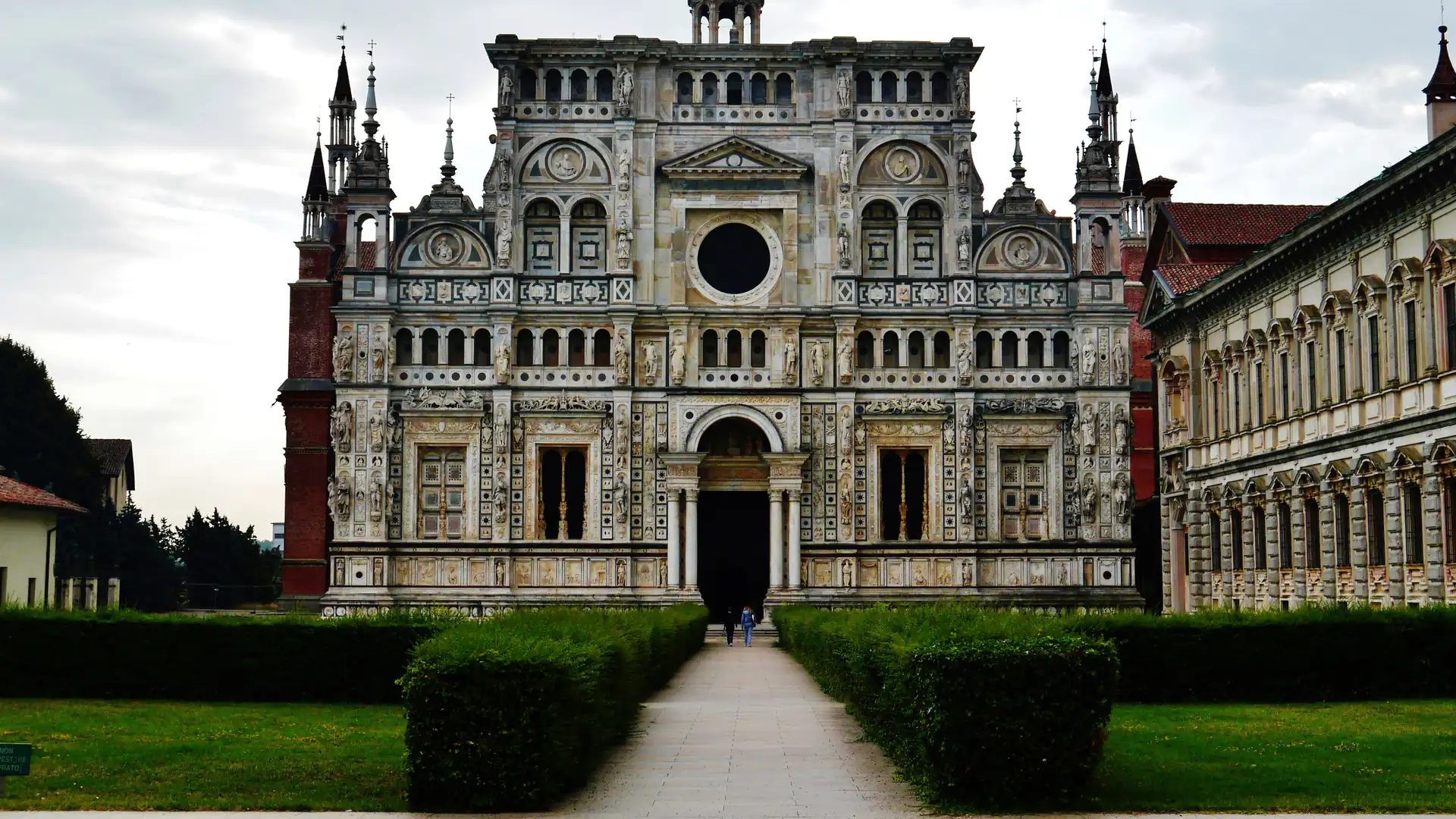
If the Certosa is your one stop of the day, make sure you give each of its parts its due rather than rushing to the famous facade and leaving. Begin in the forecourt with the facade itself, taking the long view before you step close to read the medallions, saints and reliefs carved by the Lombard masters. Pass through Briosco's portal into the church, where the Gothic-into-Renaissance interior holds the frescoes of Bergognone and the carved choir stalls — and, in the transepts, the two ducal monuments that are the reason the whole place was built: the founder Gian Galeazzo Visconti's tomb, and the tender Solari effigies of Ludovico il Moro and Beatrice d'Este.
Do not miss the old sacristy, where the Embriachi ivory triptych, more than two and a half metres tall and carved with dozens of tiny scenes, is easy to walk past if you do not know to look for it. Then give real time to the cloisters: the intimate, richly ornamented Small Cloister, and the vast Great Cloister ringed by the twenty-four little houses where the Carthusian monks once lived alone. Walking that immense quadrangle, with the church rising beyond the arcades, is the moment when the Carthusian ideal of silence and solitude becomes tangible.
A logical route — facade, church and tombs, sacristy, then cloisters — lets the visit build from public splendour to private hush, which is exactly the journey the monastery was designed to offer. Take it in that order and you leave with the whole story, not just a photograph of the front.
Making it effortless
A day trip is only relaxing if the practicalities are handled, and that is where a concierge booking earns its place. The Certosa's ticketing runs through an Italian system that is straightforward for locals but fiddly for a visitor working in another language and juggling train times, opening days and eligibility rules. We take that off your hands: you tell us your date and the tickets you need, we secure your dated admission, and your e-ticket arrives by email ready to show at the gate on your phone or a printout. There is no queuing to work out an unfamiliar platform after the journey out, and no risk of turning up on a Monday to a closed gate, because we confirm the day is open before you travel.
We are a facilitator, not the monument or its box office, and we are clear about what that means. Because your admission is secured for a specific date, all sales are final; we can offer a refund only in the event that entry cannot be honoured on the operator's side, not for a change of plans. Eligibility for the reduced tier is checked at the entrance, so carry the ID your ticket requires, and remember that under-18s and Lombardy Museum Pass holders are admitted by the monument without a ticket from us.
Within those clear boundaries our aim is simple: to make the Certosa di Pavia one of the easiest good days you will have in Lombardy. You bring the curiosity and the comfortable shoes; we make sure the ticket, the date and the plan are already in place when you arrive.
By car: a countryside loop through Lombardy
If you are travelling by car rather than train, the Certosa opens up as part of a relaxed loop through the Lombard countryside rather than a single there-and-back errand. It sits just off the SS35, the old road between Milan and Pavia, with parking near the entrance, so it is easy to reach and easy to leave. Driving gives you the freedom to arrive early, before the coaches, and to string the day together at your own pace — the monastery in the morning, Pavia for lunch, and perhaps a slower return through the flat, canal-threaded farmland that the dukes once kept as hunting parks and rice estates.
The landscape itself is part of the appeal. This is the Po plain, an intensely worked agricultural country of rice paddies, poplar rows and irrigation channels, and the Certosa rises out of it with sudden drama precisely because the land around is so level. Approaching by road you get that first distant view of the church and its tower standing above the fields, which is one of the classic images of the place and worth slowing for.
A car also makes the practical side of a family or mixed-ability visit far easier: you avoid the 1.5-kilometre walk from the station, you can carry water, layers and everything a day out needs, and you are not tied to the regional train timetable at the end of the afternoon. Bear in mind that the Certosa keeps its usual rules whether you arrive on foot or on four wheels — closed Mondays, shorter in winter, last admission thirty minutes before closing — so plan the drive around the open hours. Tell us if you are driving and we can factor it into the timing advice we give with your booking.
Where to pause and eat near the Certosa
The Certosa sits in a small village, not a resort, and knowing that shapes how you plan the middle of the day. Around the gate you will find a handful of cafes and simple trattorias where you can pause for a coffee, a pastry or an unhurried plate of local food, which is often exactly what a visit calls for — somewhere quiet to let the marble and the silence settle before you move on. It is a good idea, though, not to arrive expecting a wide choice on the doorstep, and to carry water in the warmer months when the plain gets hot.
For a proper meal, Pavia a few minutes down the line is where Lombard cooking comes into its own: risottos rich with the rice grown in the surrounding paddies, hearty plates of the Po valley, and the cafes and gelaterias of a lively university town. Pairing a morning at the Certosa with lunch in Pavia is the classic rhythm of the day, and it means you are eating at leisure in a place built for it rather than snatching something in a hurry near the gate. Milan, of course, offers everything if you are basing yourself there and returning in the evening.
Whatever you choose, build a little pause into the plan. The pleasure of a Certosa day is its calm, and rushing from the cloisters straight back onto a train undercuts the very thing that makes the trip special. A slow coffee near the monastery, or a long lunch in Pavia, is part of the experience rather than a distraction from it. If you would like suggestions tailored to your date and how you are travelling, our team is happy to point you toward the right rhythm for the day.
Frequently asked
How do I get to the Certosa di Pavia from Milan?
Take a regional train on the Milan–Pavia line to Certosa di Pavia station, roughly 30 to 40 minutes, then walk about 1.5 kilometres along a tree-lined avenue to the gate, or take a taxi or local bus. By car it is just off the SS35 road with parking near the entrance. Check return train times before you set out.
Can I visit the Certosa and Pavia in one day?
Yes, and it makes a full, rewarding day. Pavia is just eight kilometres south, a few minutes further on the same train line. Visit the Certosa in the morning when it is quietest, then continue to Pavia for lunch and an afternoon exploring its bridge, university and churches before heading back to Milan.
What day should I avoid?
Avoid Mondays: the Certosa is closed every Monday. It is open Tuesday to Sunday, with shorter hours in winter and longer hours in summer. In winter especially, start early so the mid-afternoon closing and the last admission 30 minutes before do not cut your visit short.
How much time do I need at the Certosa?
Allow around 1.5 to 2 hours to enjoy the facade, the church and its ducal tombs, the old sacristy and both cloisters without hurrying. If you are combining it with Pavia, that leaves plenty of the day for the city; don't try to cram too much into one trip.
Is it worth combining with anything else near Milan?
Beyond Pavia, the Certosa pairs thematically with Santa Maria delle Grazie in Milan, where the Sforza tomb once stood and Leonardo painted the Last Supper. Most visitors, though, find the Certosa-and-Pavia day complete in itself. Tell us your plans and we can help you sequence a wider itinerary.