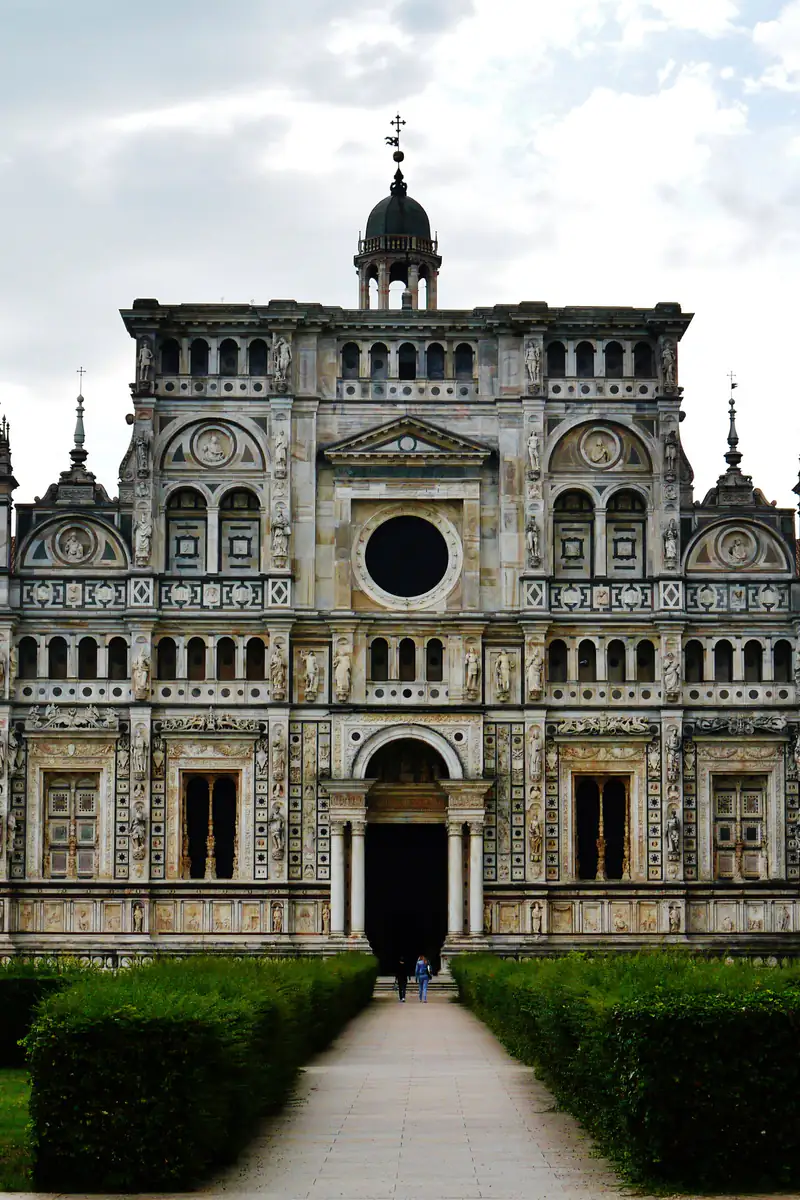
The Certosa di Pavia — the Charterhouse of Pavia — is one of the most lavish monastic buildings in Italy, raised on the flat farmland eight kilometres north of the city and roughly thirty kilometres south of Milan. Gian Galeazzo Visconti, the first Duke of Milan, laid its foundation stone on 27 August 1396, and he meant it to be two things at once: a Carthusian monastery of the strictest, most silent order, and a dynastic mausoleum grand enough to hold the memory of his house forever. The result is a building of extraordinary contradictions, where austere vows of solitude are wrapped in some of the richest sculpture and painting the Italian Renaissance ever produced.
Its famous face is the marble facade, begun in the 1470s and left gloriously unfinished at the top. Every surface within reach is carved — medallions of Roman emperors, statues of saints and prophets, reliefs of the life of Christ, inlaid coloured stone — the work of a generation of Lombard masters including Giovanni Antonio Amadeo, the Mantegazza brothers and Benedetto Briosco, whose great portal is dated 1501. Behind it stretches a church that begins in pointed Gothic and resolves into Renaissance calm, its interior consecrated on 3 May 1497, and hung and frescoed by Bergognone and other painters of the Milanese school.
The church holds the two monuments that explain why the whole complex exists. In the south transept lies the sculpted tomb of the founder, Gian Galeazzo Visconti; in the north transept stands the serene double effigy of Ludovico il Moro Sforza and his young duchess Beatrice d'Este, carved by Cristoforo Solari and moved here in 1564 from Santa Maria delle Grazie in Milan. Beyond the church open the two cloisters — the intimate Small Cloister and the immense Great Cloister, ringed by twenty-four little two-storey houses where the Carthusian monks once lived alone. A small Cistercian community keeps the monastery today, so its silence has never entirely lifted.
We are a concierge service: you choose your visit date, we arrange and secure the entry ticket on your behalf, and it arrives in your inbox as an e-ticket ready to show at the gate. No wrestling with an unfamiliar booking platform in another language, no guessing at the opening days — just your ticket, in English, in your email.