 Skip-the-line available
 How to Visit the Certosa di Pavia
A practical, room-by-room guide to visiting the Charterhouse of Pavia — opening days and hours, the quietest times, how long to allow, what you see, and how to get there.
The Certosa di Pavia rewards a little planning: it closes on Mondays, its hours shift by season, and the complex holds far more than one famous facade. Here is how to time and shape your visit.
Opening days and hours
The Certosa di Pavia keeps a clear weekly and seasonal rhythm, and knowing it before you set out is the difference between a serene visit and a wasted journey. The complex is open Tuesday to Sunday and closed every Monday without exception, so a Monday day trip simply will not work here. Through the shorter days of winter it opens from mid-morning to the late afternoon, roughly 10:00 to 16:00; in summer it stays open later, to around 18:00. In every season the last admission falls thirty minutes before closing, which matters if you are arriving by train and walking in from the station, as those final minutes can slip away before you reach the gate. Because the Certosa is a living monastery as well as a museum, its timetable can shift around religious holidays and services, and parts of the church occasionally pause for prayer. None of this is difficult to plan around once you know it: choose a Tuesday-to-Sunday date, lean toward the morning so the earlier winter closing does not squeeze your visit, and treat the posted last-admission time as a firm cut-off rather than a suggestion. When we arrange your dated entry we confirm that your chosen day is open and flag any holiday closures we know of, so you travel out from Milan or Pavia with certainty rather than crossing your fingers at the door.
The best time of day to go
Timing your arrival well transforms the Certosa from a shoulder-to-shoulder coach stop into something close to a private encounter with the marble. The complex is large and absorbs visitors better than a small chapel, but the church and the sacristy can still fill quickly when a tour group files in together, and the great facade rewards the quiet, low light of the earlier hours far more than the flat glare of midday. Two windows consistently work best. The first is soon after opening in mid-morning, before the organised groups arrive from Milan, when the forecourt is calm and the carvings of the facade catch the softer light. The second, in the longer days of summer, is the last hour or two before closing, once the day-trip coaches have started back toward the city and the cloisters empty out. The middle of the day, when several tours can overlap, is the busiest stretch. If your schedule allows a weekday over a weekend, take it: Saturdays and Sundays draw the heaviest local and day-tripper traffic, and Sunday adds churchgoers to the mix. Spring and autumn are gentler than high summer on the Lombard plain, which can be hot and humid, while winter days are short and the earlier closing rewards an early start. Because your admission is valid for the date rather than a rigid slot, you keep the freedom to pick your own moment on the day itself, reading the crowd and the light and slipping in when the complex is quietest. We secure your dated entry in advance so that, whichever window you target, you are not sorting out a ticket while the good light passes.
How long to allow
Allow more time than the word 'monastery' might suggest, because the Certosa di Pavia is really several attractions gathered behind one facade. Budget around 1.5 to 2 hours for an unhurried visit. The facade alone deserves a slow ten or fifteen minutes from the forecourt: it is carved almost inch by inch, and the roundels of emperors, the ranks of saints and prophets, and the reliefs of the life of Christ reveal themselves only if you stand back and then step close. Inside, the church rewards another good half-hour — the frescoes and altarpieces of the Lombard school, the carved choir stalls, and above all the two ducal monuments in the transepts, which are the reason the whole complex exists. The old sacristy holds the Embriachi ivory triptych, a miniature masterpiece easy to miss if you hurry, so give it a few minutes of real attention. Then come the cloisters: the intimate Small Cloister with its terracotta ornament, and the vast Great Cloister, whose scale and twenty-four little cells take time simply to walk around and absorb. Photographers, sculpture enthusiasts and anyone travelling with a guide should budget toward the upper end, closer to two hours or more. Families with children often move faster through the church but linger in the great open cloister, which holds attention well. As a rule of thumb, block out a good part of a morning if you want to see everything without rushing, and remember that the earlier winter closing leaves a narrower window in which to fit it all.
What you see, room by room
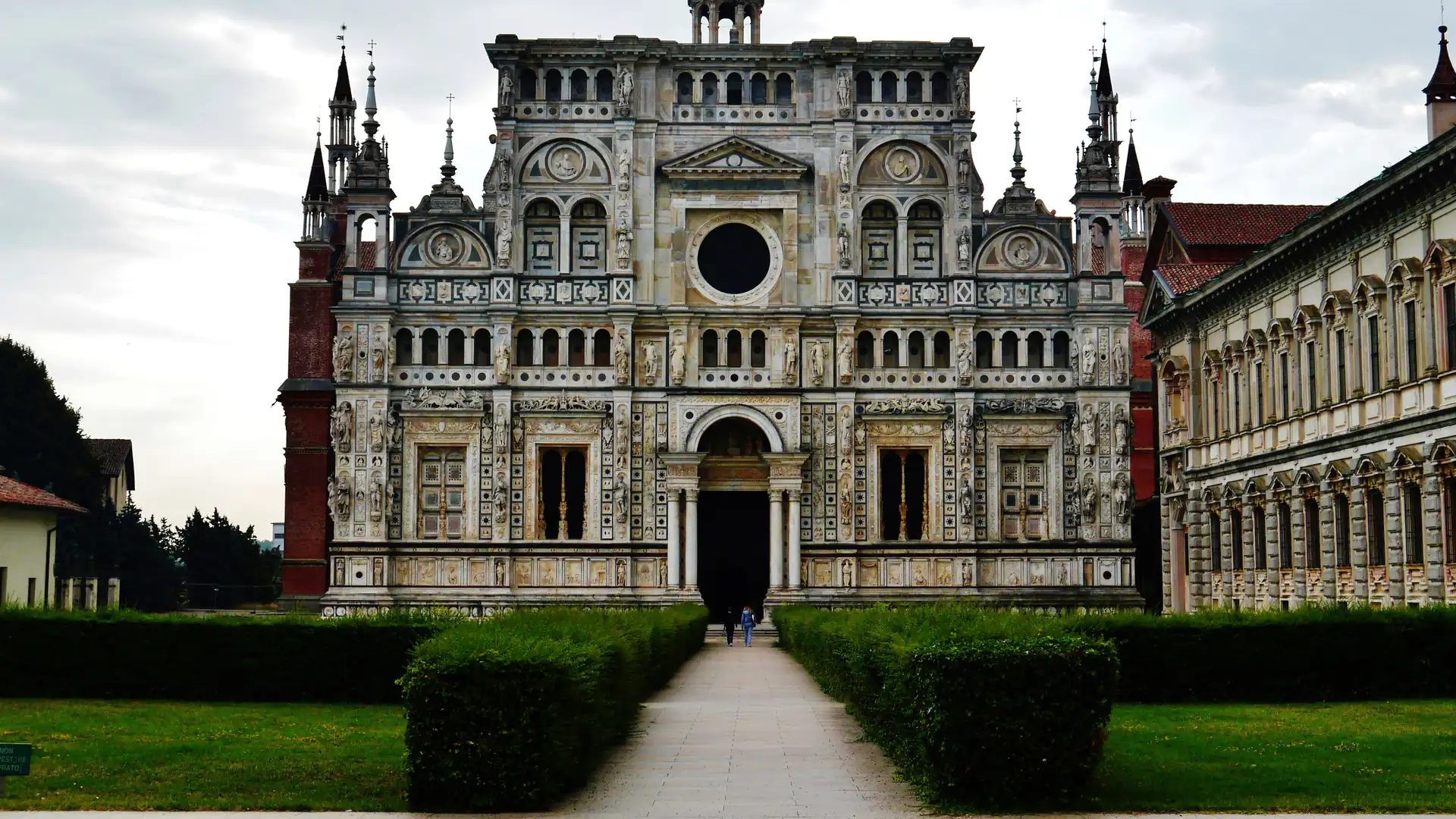
A visit unfolds in a clear sequence, and knowing the layout helps you spend your time where it counts. You begin in the great forecourt, facing the facade — the single most photographed sight of the complex, begun in the 1470s and carved by Lombard masters including Amadeo, the Mantegazza brothers and Benedetto Briosco, whose central portal is dated 1501. Take it in from a distance first, then approach to read the detail. Through the portal you enter the church, a soaring three-aisled space that shifts from pointed Gothic to Renaissance calm, frescoed by Bergognone and others of the Milanese school and consecrated in 1497. The two monuments in the transepts are the heart of the visit: in the south transept the sculpted tomb of the founder, Gian Galeazzo Visconti; in the north, the tender double effigy of Ludovico il Moro Sforza and Beatrice d'Este by Cristoforo Solari, a cenotaph brought here in 1564 from Santa Maria delle Grazie in Milan. Off the church lies the old sacristy and its ivory-and-hippopotamus-tooth triptych by the Embriachi workshop, more than two and a half metres tall and crowded with tiny carved scenes. From there the route opens into the cloisters: first the richly decorated Small Cloister with its garden, then the immense Great Cloister, ringed by the twenty-four two-storey cells where the Carthusian monks lived alone. A small Cistercian community keeps the monastery today, so the living quarters themselves stay closed, but the cloister is the part of the visit that most vividly shows how the monks lived. Let the sequence build — facade, church, tombs, sacristy, cloisters — and you leave with the whole story of the place.
Photography, dress and etiquette
The Certosa di Pavia is a working monastery and church, not simply a museum, and a few courtesies keep the visit smooth for everyone. Photography for personal use is generally welcomed in the open areas — the facade, the forecourt and the cloisters make wonderful pictures — but flash is not permitted, as it is harmful to the centuries-old paintings and disruptive to other visitors, and tripods and selfie sticks are not allowed, so plan to shoot handheld. Inside the church photography may be restricted, especially during services or out of respect for the community's life of prayer; watch for signs and follow the staff's guidance. Dress modestly, as you would for any active church: shoulders and knees covered is the safe standard, and it is worth carrying a light scarf or wrap in summer when you might otherwise be in a vest and shorts. Visitors are occasionally asked to cover up at the entrance, so dressing appropriately from the start saves disappointment after the journey out. Inside, keep your voice low and silence your phone; the hush is part of what makes the Certosa so memorable, and it belongs to a community that has kept it for centuries. Do not touch the marble, the tombs or the fittings, and be mindful in the church that this is a place of worship first. Bags may be subject to security checks at the entrance, so travel light. These are the same simple manners you would extend to any living sacred site, and they let the Certosa keep the atmosphere of contemplation that its founders built it for.
Accessibility
The Certosa di Pavia is a monastery more than six hundred years old in continuous religious use, so accessibility is a mix of thoughtful provision and inevitable historic constraint, and it helps to know what to expect. The main spaces — the church, the sacristy and the cloisters — are largely at ground level, which makes much of the visit navigable, but the surfaces are historic: the forecourt and cloister walks include gravel and old stone paving that can be uneven, and thresholds and a few steps appear between spaces. The church interior is deliberately dim, which is worth bearing in mind for visitors with low vision. There is space to pause and sit, and the overall route is not long, though the Great Cloister is a wide open space that takes time to cross. The approach from the station involves a walk of around 1.5 kilometres along a straight avenue, which some visitors with limited mobility may prefer to replace with a taxi or car drop-off closer to the gate; there is parking near the entrance for those arriving by road. Because a religious community lives here, some areas are closed regardless of access, and arrangements can vary with the day and any service in progress. Assistance dogs are the usual exception to any restriction on animals. Since requirements differ so much from visitor to visitor, the surest approach is to tell us what you need when you book: we can pass on the current guidance on step-free routes and on-site assistance and help you plan an arrival that works, so there are no surprises at the door.
Getting there
The Certosa di Pavia stands on the plain about eight kilometres north of Pavia and roughly thirty kilometres south of Milan, which makes it an easy half-day from either city and a natural pairing with a stop in Pavia itself. The simplest approach is by regional train: services on the Milan–Pavia line stop at the station of Certosa di Pavia, from which it is a straightforward walk of about 1.5 kilometres along a tree-lined avenue to the monastery gate. From Milan the train takes roughly 30 to 40 minutes; from Pavia it is only a few minutes, so many visitors combine the two. Regional buses also serve the village if you would rather not walk from the station. Arriving by car, the Certosa lies just off the SS35 road between Milan and Pavia, with parking available near the entrance — a good option for families or anyone carrying a lot, and the quickest door-to-door route. Whichever way you come, aim to arrive mid-morning: the light on the facade is at its best, the cloisters are at their calmest before the coach groups gather, and on a short winter day you keep the whole of the open hours ahead of you. Once you are at the gate the layout is simple and clearly signed, and the village around it offers a few cafes for lunch before the journey back. We confirm your dated entry in advance, so arrival is simply a matter of turning up on the day you chose with your e-ticket ready on your phone.
Facilities and practical notes on the day
A few practical details make the day run more smoothly. The Certosa sits in a small village rather than a city centre, so plan your refreshments around that: there are cafes and a trattoria or two near the gate for a coffee or a simple lunch, but the wider choice is back in Pavia or Milan, and it is wise not to arrive ravenous late in the day. Bring water in summer, when the Lombard plain is hot, and a scarf or wrap year-round so you are ready for the modest-dress expectation at the church. Comfortable shoes help, both for the walk in from the station and for the gravel and old stone of the forecourt and cloisters.
Entry is by date, so there is no rigid clock time to hit, but do keep the last-admission rule in mind — thirty minutes before closing, and earlier in winter than in summer. Bags may be checked at the entrance, so travel light, and large luggage is best left at your hotel or a station locker rather than carried around the complex. Your e-ticket works from your phone; if you prefer a printout, bring one, and either way have any ID your tier requires to hand.
Because the Certosa is a living monastery, remember that its rhythms are not purely those of a museum: a service may be in progress, an area may be quietly closed, and photography inside the church may be limited. None of this detracts from the visit — it is part of what makes the place feel authentic rather than staged — but arriving aware of it means you meet the day with the right expectations. If anything about your particular plan is uncertain, from accessibility to a possible holiday closure, tell us when you book and we will check it and pass on what we learn before you travel.
Frequently asked
What are the Certosa di Pavia's opening hours?
It is open Tuesday to Sunday and closed every Monday. Winter hours are roughly 10:00 to 16:00 and summer hours extend to about 18:00, with last admission 30 minutes before closing. Because it is a working monastery, times can shift for holidays and services, so choose an open day and we'll confirm it.
How long should I allow for a visit?
Allow around 1.5 to 2 hours to enjoy the facade, the church and its ducal tombs, the old sacristy with its ivory triptych, and the two cloisters at a comfortable pace. Photographers and sculpture lovers should budget toward the upper end, and remember the earlier winter closing.
When is the Certosa least crowded?
Soon after opening in the mid-morning is quietest and best for the facade, before the coach groups arrive from Milan. In summer the last hour or two before closing is also calm. Weekdays are quieter than weekends, and Sundays add churchgoers to the mix.
Is there a dress code, and can I take photos?
Yes to modest dress: it is a working monastery, so cover shoulders and knees and carry a scarf in summer. Photography without flash is generally fine in the open areas, but flash, tripods and selfie sticks are not allowed, and photography may be restricted inside the church.
How do I get to the Certosa di Pavia?
Regional trains on the Milan–Pavia line stop at Certosa di Pavia station, about a 1.5 km walk from the gate; buses also serve the village. By car it is just off the SS35 road with parking nearby. From Milan allow roughly 30 to 40 minutes by train, and only a few minutes from Pavia.