 Skip-the-line available
 The Ducal Tombs of the Certosa di Pavia
Why a duke built a monastery to be buried in — the tomb of Gian Galeazzo Visconti, the Solari effigies of Ludovico il Moro and Beatrice d'Este, and the mausoleum idea behind it all.
The Certosa di Pavia is, at heart, a tomb — a monastery founded so that a dynasty could be remembered forever. Two great monuments in its transepts hold that story in marble.
A monastery built to be a mausoleum
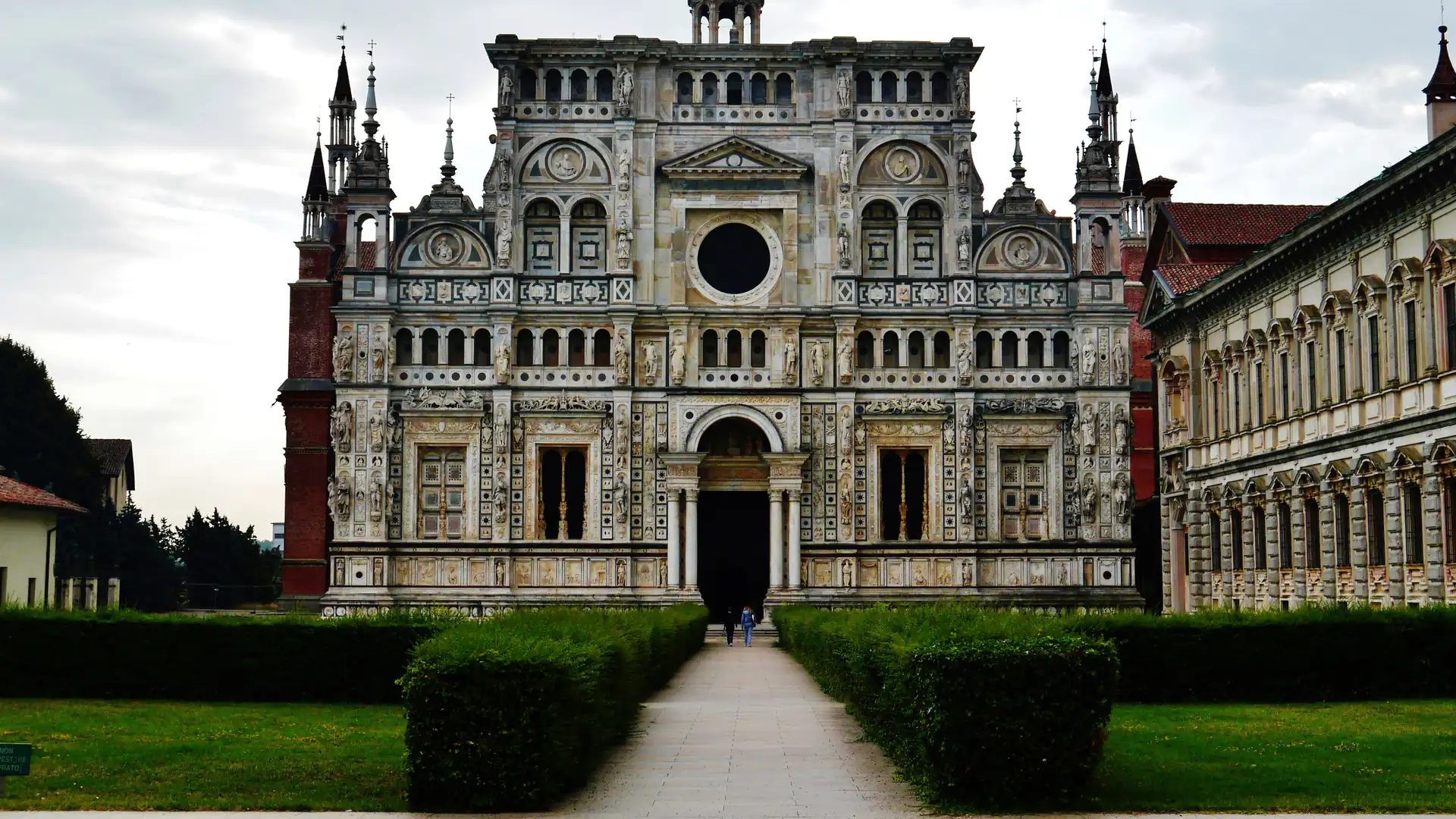
To understand the tombs you have to understand why the Certosa exists at all. When Gian Galeazzo Visconti, the first Duke of Milan, laid the foundation stone in 1396, he was not simply endowing another monastery. He was building a mausoleum for his house — a place where the Visconti, and the age they ruled, would be honoured and prayed for in perpetuity by a community of monks whose whole life was devoted to prayer. The Carthusians were the ideal keepers of such a memory: silent, disciplined, and vowed to intercede day and night. The magnificence of the church, and above all the monuments within it, flow directly from that founding purpose.
This is why the Certosa feels different from an ordinary abbey. Its splendour is funerary and dynastic as much as devotional; the building is a statement addressed to eternity on behalf of the family that raised it. The dukes gave the monks a home and an endowment; in return the monks kept the family's memory alive before God.
Seen in that light, the two tombs in the transepts are not incidental decorations but the reason for everything around them. The facade, the frescoes, the cloisters — all of it frames these monuments and the remembrance they were built to secure. Walk into the church knowing that, and the tombs stop being a stop on a tour and become the beating heart of the place.
The tomb of Gian Galeazzo Visconti
In the south transept of the church stands the monument to the founder himself, Gian Galeazzo Visconti, who died in 1402, only a few years after laying the first stone of the monastery he intended as his resting place. The tomb is a grand architectural composition in marble, rising in tiers with the recumbent effigy of the duke above and sculpted figures, reliefs and ornament framing him — a fitting memorial to the man who forged the Duchy of Milan and dreamed the Certosa into being.
The monument was long in the making. It was worked on by sculptors including Giovanni Cristoforo Romano, who contributed to the effigy and figures around the turn of the sixteenth century, and Benedetto Briosco, and it was not brought to completion until 1562 — a century and a half after the duke's death. That slow, layered creation is typical of the Certosa, where the greatest works were assembled over generations rather than in a single campaign.
Standing before it, you are looking at the culmination of the founder's entire project. Everything else at the Certosa — the silent order, the lavish facade, the endowment of land that made the monastery one of the richest in Lombardy — was set in motion so that this man and his line would be remembered here. The tomb repays slow looking: study the effigy, the surrounding figures and the reliefs, and read it as the personal centre of a monument that is otherwise addressed to the whole world.
Ludovico il Moro and Beatrice d'Este
Across the church, in the north transept, lies the most quietly affecting sculpture in the Certosa: the double funerary effigy of Ludovico Sforza, called il Moro, and his wife Beatrice d'Este. The two lie side by side in marble, serene and composed, their features carved with a tenderness that has made the monument famous. It is the work of Cristoforo Solari, one of the leading sculptors of Sforza Milan, and it captures the couple at the height of the brilliant, doomed court that Ludovico presided over — the same court that employed Leonardo da Vinci.
There is a poignant twist to the monument. Beatrice d'Este died young, in 1497, and the effigies were originally made for the choir of Santa Maria delle Grazie in Milan, the church Ludovico favoured and where Leonardo painted the Last Supper. Ludovico's own fortunes collapsed soon after; he lost Milan and died a prisoner in France. The tomb the couple intended was never used as planned, and the marble effigies were eventually transferred to the Certosa in 1564, where they found a permanent home among the ducal monuments.
Strictly speaking the Sforza monument here is a cenotaph — an empty memorial rather than a grave — which only deepens its melancholy. Two of the most powerful figures of Renaissance Italy lie carved in eternal rest in a monastery church, far from the city they ruled, their glory outlived by the marble that records it. For many visitors these effigies, more than anything else in the Certosa, are the image they carry away.
The art of the Renaissance tomb
The two monuments at the Certosa are also a lesson in how the Italian Renaissance thought about death, memory and the image of a ruler. A great tomb of this period was never only a grave marker; it was a work of persuasion, designed to fix a person's dignity, virtue and status in the mind of everyone who saw it. The recumbent effigy, calm and idealised, presents the dead not as they were in their last hours but as they wished to be remembered — powerful, pious, serene. The architecture, figures and reliefs around them borrow the vocabulary of classical antiquity to lend the memorial the authority of Rome.
Seen together, the Visconti and Sforza monuments show two moments in that tradition. The founder's tomb, assembled over many decades, is grander and more architectural, a towering dynastic statement. The Sforza effigies are more intimate and humane, two figures side by side, their appeal emotional rather than monumental. Between them you can read the movement of Lombard sculpture across the decades, much as you can across the facade outside.
That is why the tombs reward more than a passing glance. Look at how the sculptors handled faces and hands, drapery and ornament; notice what each monument is trying to say about the person it commemorates. The Certosa gathers, in one church, some of the finest funerary sculpture of northern Italy, and understanding what such tombs were for makes standing before them far more than sightseeing.
Seeing the tombs well on your visit
The tombs lie in the transepts of the church, to either side of the main altar, so you will come to them naturally as you move through the interior. To see them at their best, aim for a calmer moment — soon after opening, or in summer toward the end of the day — when the church is quiet enough to give each monument the attention it deserves. The interior is deliberately dim, part of its contemplative atmosphere, so allow your eyes to adjust and take your time; the effigies and reliefs slowly reveal their detail as you look. Remember that photography inside the church may be restricted, and that services can occupy the space, so follow any guidance from the staff and keep your voice low, as you would in any working church. If you would like the full story of the Visconti and the Sforza, the doomed brilliance of Ludovico's court and the slow making of the founder's monument, a guided visit can bring the history alive as you stand before the marble; tell us your date and group size and we can help you arrange one. However you visit, we are a concierge service that secures your dated entry in advance for your chosen day, so you can concentrate on the tombs and the church rather than on ticketing. Entry is valid for the date you select rather than a fixed hour, which gives you the freedom to reach the Certosa at the calmest time and linger in front of the monuments that are, in the end, the reason the whole extraordinary complex was ever built.
The Carthusians who kept the memory
A mausoleum needs keepers, and the whole point of founding a monastery rather than merely raising a tomb was to secure a community whose life would be devoted to remembering the dead. The Carthusians were chosen precisely because their vocation suited that task. Theirs is among the most austere of all religious orders: each monk lived alone in one of the little two-storey cells around the Great Cloister, keeping silence, praying through the day and much of the night, and meeting the others only rarely. When the church was consecrated in 1497 the community was established at double the usual size, so that a full two dozen monks would keep the round of prayer and intercession going for the Visconti and Sforza souls.
That is the human engine behind the splendour. While the dukes provided the marble, the frescoes and one of the largest monastic endowments in Lombardy — thousands of hectares of farmland worked to support the house — the monks provided the prayer that the whole foundation was meant to buy. The contrast could not be sharper: worldly magnificence on the walls, unworldly poverty and silence in the cells, bound together by a single bargain between a dynasty and an order.
Knowing this changes how the tombs read. They are not isolated monuments in a museum but the focus of centuries of daily remembrance by men who never sought fame and are themselves anonymous. When you walk from the ducal effigies out to the Great Cloister and see the cells ranged around it, you are seeing the two halves of the founder's plan side by side — the remembered and the rememberers. A small Cistercian community continues that monastic life today, so the Certosa has never entirely stopped being what Gian Galeazzo intended: a place where prayer is kept.
A dynasty outlived by its marble
There is a deep irony written into the tombs, and it is part of what makes them so affecting. The Visconti and the Sforza built the Certosa to guarantee their memory for eternity, yet their political power proved anything but eternal. Gian Galeazzo Visconti died in 1402, and within a generation his line gave way to the Sforza. Ludovico il Moro, whose court was among the most brilliant in Europe and who employed Leonardo da Vinci, lost Milan to the French and died a prisoner far from home; his young wife Beatrice d'Este had already died in 1497, still in her twenties. The dazzling world they represented was swept away within their own lifetimes.
What survived was the stone. The effigies carved by Cristoforo Solari, made for a church in Milan and brought to the Certosa in 1564, outlived the couple's power, their city and their dynasty, and they endure today as the serene, sleeping image the Sforza wished to leave behind. The founder's own monument, finished only in 1562, likewise long outlasted the Visconti themselves. The mausoleum did its work, but not quite as intended: it preserves not the living authority of a ruling house but the memory of a vanished age.
For the visitor, that turn of fortune is exactly what gives the tombs their weight. To stand before them is to feel the gap between ambition and outcome — between rulers who commanded armies and cities, and the quiet marble that is all that now remains of them, tended by monks in a monastery on the plain. The Certosa set out to defeat forgetting, and in a sense it succeeded: five centuries on, travellers still come to look on the faces of the men and women who built it, which is more than most of the powerful can claim.
Frequently asked
Who is buried at the Certosa di Pavia?
The great monuments are the tomb of the founder, Gian Galeazzo Visconti, first Duke of Milan, in the south transept, and the double effigy of Ludovico il Moro Sforza and Beatrice d'Este in the north transept. Other members of the ducal families are also commemorated in the church.
Why is the Sforza tomb called a cenotaph?
A cenotaph is a memorial that does not contain the body it honours. The marble effigies of Ludovico il Moro and Beatrice d'Este were carved by Cristoforo Solari for Santa Maria delle Grazie in Milan and moved to the Certosa in 1564, so the monument here commemorates the couple without being their grave.
Who carved the effigies of Ludovico and Beatrice?
They are the work of Cristoforo Solari, a leading sculptor of Sforza Milan. Beatrice d'Este died young in 1497 and the effigies were first intended for Santa Maria delle Grazie, the church where Leonardo painted the Last Supper, before being transferred to the Certosa in 1564.
When was the founder's tomb finished?
Gian Galeazzo Visconti died in 1402, but his monument was built over generations by sculptors including Giovanni Cristoforo Romano and Benedetto Briosco, and was not completed until 1562. Its slow, layered creation is typical of how the Certosa's greatest works were assembled.
Can I photograph the tombs?
Photography inside the church may be restricted, particularly during services or out of respect for the community's life of prayer, so watch for signs and follow the staff's guidance. In the open areas of the complex, photography without flash is generally allowed.